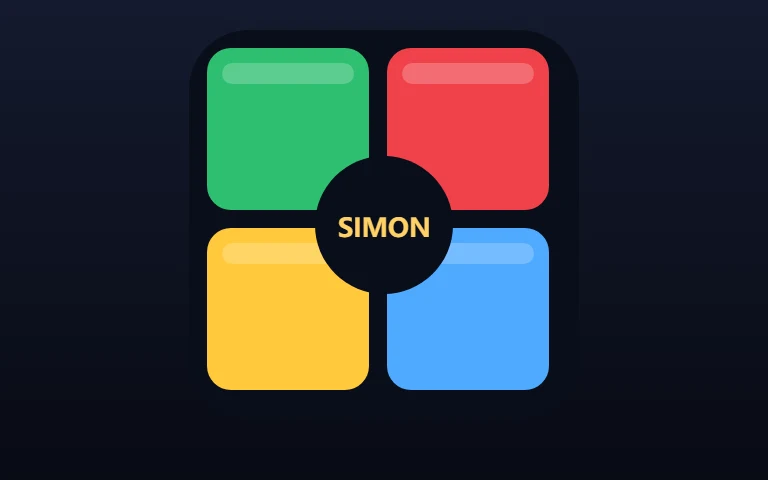
Simon Says is a memory game where the sequence grows forever and your recall does not. The gap is closed with technique, not talent.
The seven limit is real
Working memory holds roughly seven items for most people. Repeating a sequence by rote will carry you into the low teens at best, then collapse. Everything past that comes from re-encoding the sequence into less memory-hungry shapes.
Chunk into pairs and runs
The strongest technique is grouping. Read the sequence not as pads but as transitions:
- A pair like "red, red" is one item: "double red".
- A run like "green, blue, yellow" can be held as a shape: "the L" — your hand can even trace it.
- A repeated pair that returns later ("red, red" again) is a bookmark.
A twenty-item sequence of four pads is really about ten chunks, and ten chunks fit in working memory. The savings are not marginal; they are the whole game.
Say it, do not just see it
Sound is part of this game — every pad has a tone. Using two channels instead of one roughly doubles what you can hold. The practical version: mouth the sequence silently as it plays, or tap the rhythm on your knee.
Sub-vocalising also protects against a specific failure: on long sequences, players lose their place halfway. A rhythm you are producing yourself is much harder to lose than a rhythm you are only watching.
The sequence is a song. Memorise the song, not the notes.
Type it back at speed
The replay phase has its own trap: hesitating. Once you are 70% sure of the next chunk, press it — the extra confirmation second is where place-holding errors are born.
And if you do lose your place, commit to your best guess rather than stalling. A wrong pad ends the run, but so does a ten-second stall in most people's nervous systems; confidence at least keeps the rhythm intact.
Watch one round ahead
Around the mid-teens, sequences get long enough that trying to hold the whole thing fails. The fallback: hold the first half precisely, watch the second half twice as attentively, and rely on the fact that early items repeat as anchors while you re-encode them.
It buys two or three rounds past your natural limit — which, in a game of one wrong pad, is a very large distance.