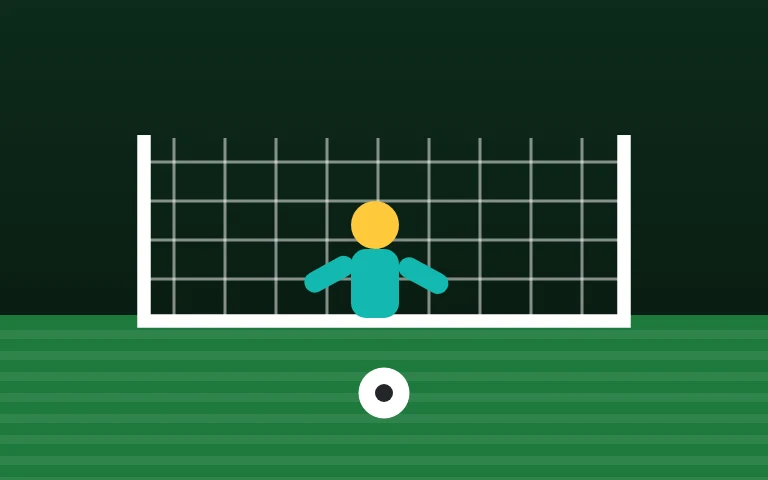
Five shots decide the tie. The keeper dives, the ball travels, and the difference between winning and losing is usually not power but placement consistency.
The three zones that score
Think of the goal as three scoreable bands: low corner, high corner, and the gap just above the keeper hip. The centre is not a band; against a diving keeper it is either a lucky miss or an easy save.
Low corners are the highest percentage shot in this game. The ball reaches the corner before the keeper covers the ground, and unlike the top corners it cannot sail over the bar.
Power is a precision tax
Full power narrows your margin: a shot that is two degrees off at full power misses the frame, while the same two degrees at 70 percent power still finds the corner.
The working rule is 65 to 80 percent power for corners, full power only when you are aiming at the middle third of the goal and simply want to beat the keeper by speed.
Do not repeat yourself
If you score in the same corner twice, the keeper starts anticipating it. Against a CPU that adapts, the third shot to that corner is the one that gets saved. A simple rotation — low left, low right, high left, low right, low left — is enough to stay unpredictable without losing accuracy.
Reading your own miss
A miss high is a power problem. A miss wide is an aim problem. A save is a placement problem: you hit the ball within the keeper reach, usually because you aimed at the same side twice or aimed too close to the middle.
Adjust one variable at a time. Changing both power and aim after a miss usually produces a worse shot than the one you just took.
When you are behind
If the CPU has scored more than you with two shots left, stop aiming at corners. Go for the fastest shot you can put on target and hope for a rebound situation — precision takes time you no longer have.
If you are ahead, do the opposite: keep every shot inside the frame, accept a save, and let the clock work for you.
The shootout checklist
- Pick a side before you aim; do not let the aim drift to the middle.
- Set power at 70 percent.
- Aim one ball-width inside the post.
- Change sides on the next shot.
Five shots is short enough that discipline beats creativity every time.