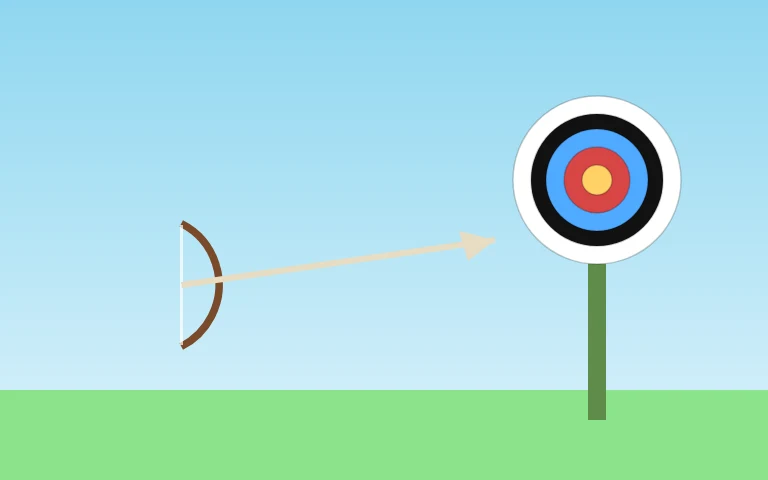
Archery is the cleanest physics game on the site: a slingshot pull, a wind that changes every shot, and a target. Nothing random happens after release — which means every miss is information.
The pull does two jobs
Drag length sets arrow speed, and drag direction sets launch angle. Because gravity is constant, the two combine into one skill: finding, for each wind, the pull that lands centre.
The efficient way to learn it: keep the angle fixed and adjust only length for the first two arrows. One variable moves, one variable learns. Players who adjust angle and length simultaneously on every shot learn nothing from their misses.
Wind is a shift, not a mystery
The crosswind changes each shot and pushes the arrow sideways. The important thing about it: it changes by a readable amount, and it is the only thing that changed.
So treat wind as a shifting offset on a constant system. If your last shot with no wind landed centre, and this shot has wind pushing right, the correction is left by an amount you can estimate from how strong the wind looks — then refined by where the arrow actually landed.
One adjustment per shot, never two. If you change your angle *and* your length *and* your wind read at once, you cannot know which one fixed or broke the shot.
The target is a spreadsheet. Every arrow is one row of data.
Aim small at the end
The rings pay a lot for the centre, and the last arrows decide the round. But the bull is small, and a wide miss scores nothing. The mature pattern: once you are landing within the inner rings consistently, keep the same pull and let the accuracy pay; do not stretch for the centre with a new technique on arrow five.
The flag lies a little
The wind flag shows direction and rough strength, and players stare at it. Stop. The flag tells you which side the wind is on; your previous arrow's landing tells you how much. Direction from the flag, magnitude from the data.
Six arrows, one system
Round structure: arrows one and two are calibration at safe pulls, arrows three and four are the working shots where the corrected system pays, arrows five and six are the payoff at the tightest aim you have earned.
That arc — calibrate, correct, cash — is the whole sport. Nothing in it requires fast hands; it requires writing down, in your head, what each arrow taught you.