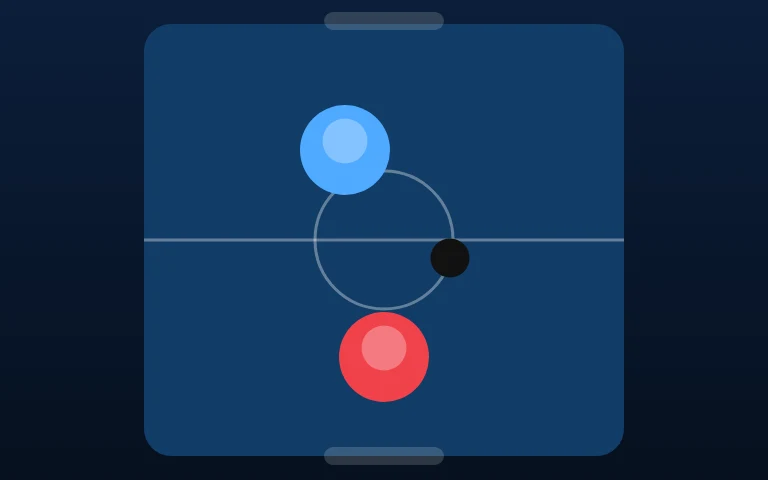
Air hockey against a computer that hits hard on the counter is a positioning game. The mallet that moves the least, wins — because a mallet that is always where the puck is going does not need to swing.
Own the defensive third
The computer defends its half and attacks yours. The mistake beginners make is chasing the puck into their own half with a full swing, which leaves the goal wide open the moment the puck ricochets.
The correction is to play a stationary block: park the mallet just in front of your goal mouth, slightly toward the centre. From there:
- Straight shots hit you and bounce away.
- Angled shots are the only ones that can score, and you can read the angle before it arrives.
You concede almost nothing by blocking. You concede a lot by swinging.
Block, do not slap
A slap is a full-speed swing at the puck. It feels powerful and it loses points, because the direction of a slap is whatever your hand happens to be doing.
The scoring shot in this game is the shove: move the mallet into the puck from a short distance, so the puck leaves with speed but a direction you chose — usually toward a corner, away from the AI mallet.
A fast puck in a random direction is a turnover. A medium puck at the AI far corner is a shot on goal.
Bait the counter
The AI hits hard when the puck comes toward it fast and straight. That is not a weakness — it is a pattern you can farm.
Feed it a straight, medium-speed puck down the middle. It will strike back hard, usually along a predictable line. Because you stayed home near the goal, its counter arrives in front of your block, you absorb it, and the rebound sits in the middle of your half with the AI out of position. Shove it to a corner before the mallet recovers.
That loop — feed, absorb, counter — is where most of your goals come from.
The two dangerous moments
- After your own shot. If you swung forward, you are out of position for the return. Recover to the block position immediately, before the puck even crosses the centre line.
- Corners of your half. The AI aims bank shots at the wall behind your goal. When the puck goes into your corner, do not chase it deep; cover the goal line and let the wall do the work.
First to seven
Points in a game to seven come in pairs — one clean goal, then one counterattack goal while the opponent is still angry about the first. Stay disciplined after scoring: the very next face-off is when careless players get burned.
And when you lead 6–3, switch fully to block mode. You do not need style; you need three more blocks.