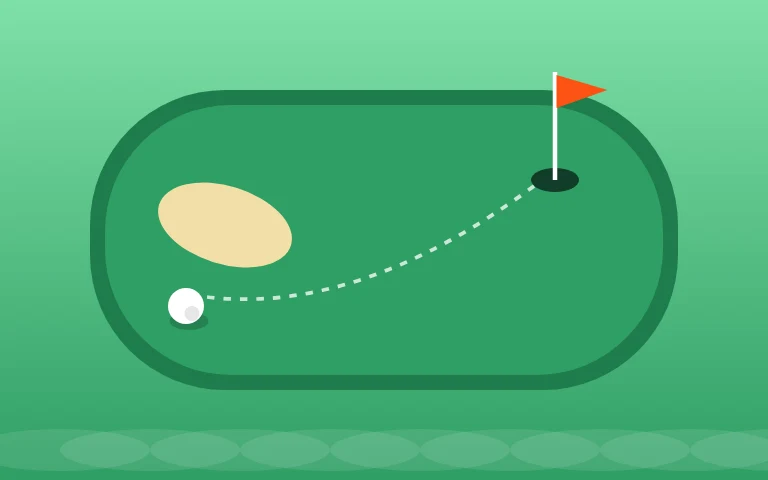
Golf Challenge compresses putting into a single drag. Pull back for power, release to strike. Everything else — slope, walls, bunkers — is read from the behaviour of the ball, and you only get so many strokes.
The first putt is information
On an unfamiliar hole, do not aim at the cup. Aim at the middle of the green with moderate power. You will learn three things from one stroke: which way the slope pushes at slow speed, how much the walls return, and how much power a full green needs.
The second putt, aimed with that information, is worth more than a lucky first hole-in-one.
Power has a floor and a ceiling
Too little power stops short and leaves you a tap-in. Too much power runs past the cup and, on these lanes, often bounces back off the far wall into a worse line.
The reliable power band is the one that brings the ball to rest one to two ball-widths past the cup. Aim for the cup with that margin rather than aiming to stop exactly on it.
Aim for the entry side
Every cup has an approach that works better. Aim so the ball arrives from the high side of the slope, not the low side. Coming in from the high side, the slope slows the ball into the cup; coming in from the low side, the slope pulls it away exactly when you need precision.
If the green slopes toward the left, enter from the right.
Walls are your friend, once
A wall bounce is predictable: the angle in mirrors the angle out. That makes a bank shot a legitimate way to reach a cup behind a bunker.
But every bounce costs speed. Use a wall only when the direct line is blocked, and add roughly a fifth more power for one bounce and a third more for two.
Bunkers and the two-putt mindset
Bunkers kill your roll. If the ball lands in one, the hole becomes a damage-control exercise: get out with the minimum power that clears the sand, accept the two-putt, move on. The players who lose this game are the ones who try to save a bunkered hole with a hero shot and end up three-putting.
A simple routine
- Look at the hole and decide the entry side.
- Pick a target one ball-width on the high side of the cup.
- Set power so the ball would travel two ball-widths past the cup.
- Do not adjust after you start the pull; commit and release.
Three holes is short. One wasted stroke from a half-hearted pull costs more than any misread slope.