Every 2048 board tells you how it will end. If your biggest tile wanders around the middle of the grid, the run is already over — you just have not lost yet. The fix is not a trick, it is a rule you refuse to break.
Why the corner works
A corner tile has only two neighbours. Every merge you make toward it is a merge that cannot be blocked from three other directions. Players who keep their 512 in a corner can usually describe, at any moment, which two columns feed it. Players who let it drift cannot.
Pick one corner on move one and treat it as property. For most people the bottom-left corner is easiest, because the natural swipe rhythm (left, down) keeps pushing mass in that direction.
Build a descending staircase
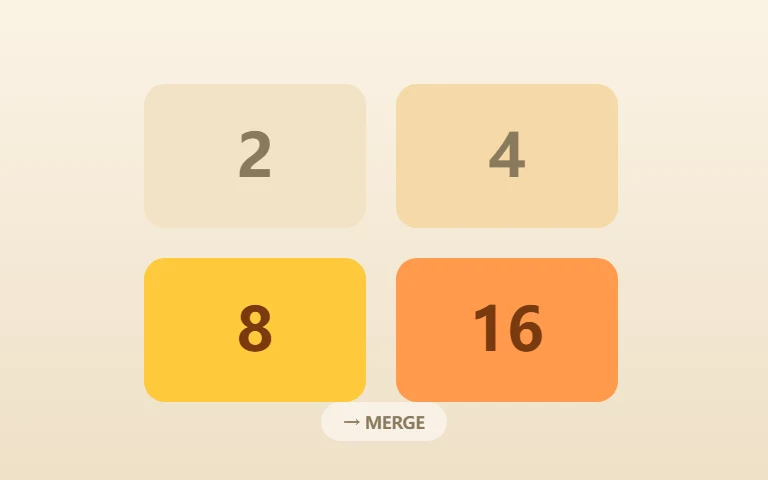
The real unit of 2048 is not the big tile, it is the row. Aim for a bottom row that reads like 256, 128, 64, 32 from the corner outward — each tile double the next. When the row is ordered, a single left swipe merges the small pairs and tightens the row without disturbing the big tile.
Two habits protect the staircase:
- Never swipe the row that holds your biggest tile in the direction that pulls it away from the corner.
- Keep the two cells next to the big tile small. A 2 or a 4 is a buffer; a 64 there is a traffic jam.
The three-swipe rule
Before a swipe, ask what the board looks like after the new tile spawns. If two of your three safe directions would leave a gap in the staircase, take the risk now rather than later — later is when the gap costs you the run.
In practice this means you spend most of the mid-game alternating between two directions: one that slides mass toward the corner, one that stacks the free row. The other two directions are emergencies only.
When the corner gets blocked
It will happen. A 2 spawns in the worst cell and the bottom row can no longer merge left. Do not panic-swipe up. Instead:
- Clear the row above the corner with vertical swipes until there is space.
- Feed the corner tile one merge at a time from the row above.
- Restore the staircase before chasing score again.
Reading the board instead of the score
Score is a lagging indicator. The number that matters is free cells. Above six free cells you can absorb almost anything. At three free cells, every swipe is a coin flip. At one, you are already choosing how to lose.
If you want a simple drill: play ten runs where you never let the free-cell count drop below four, and accept a lower score. The habit transfers, and the scores come back higher within a week.
Common mistakes
- Swiping up out of habit. In the corner method, up is a demolition tool, not a movement.
- Merging the buffer tiles too eagerly. A spare 2 gives you a legal move when the board is tight.
- Chasing 1024 in the middle of the board because it feels faster. It is faster, and it ends sooner.
- Resetting after one bad spawn. Most boards are recoverable at five free cells.
The 2048 tile is not a skill check. It is what happens when you keep the corner clean for four hundred moves.