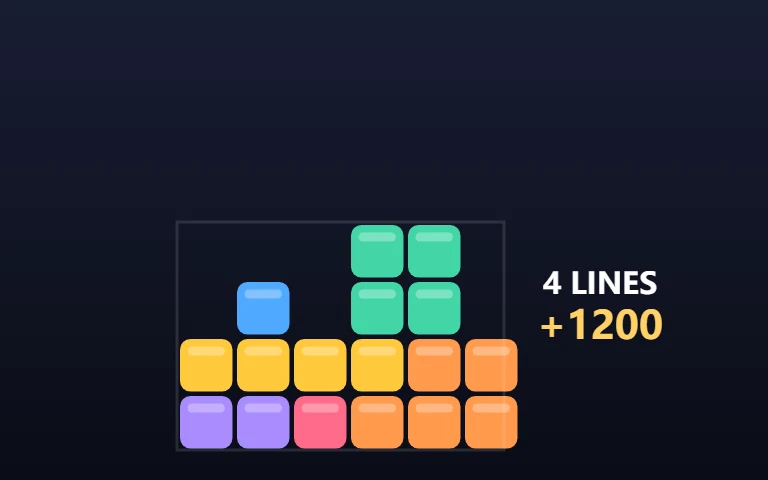
Most players lose Block Cascade the same way: a hole appears under a stack, they build over it, and ten lines later the well is unusable. The fix is a stacking contract you follow even when it feels slow.
The well: one column, always clear
Choose the far-left or far-right column as your well and never build in it unless you are clearing a line. Four vertical cells is the most efficient scoring space on the board, and it only works if it is empty when you need it.
The well is not a dump. It is a vertical runway for the I-piece. Everything else on the board exists to keep that runway clear.
Flat is faster than pretty
A flat surface with no overhangs beats a tidy-looking staircase almost every time. When the stack is flat, any piece has a legal landing spot. When the stack has a two-cell notch, half your pieces need a specific rotation to fit and your thinking time collapses.
Two rules keep the surface flat:
- Never place a piece so that it creates a covered cell, even if the placement scores well right now.
- When you have a choice, place the S and Z pieces on the side where their step matches the existing height, not where it looks symmetric.
Rotation discipline
Amateur play rotates pieces four times looking for a fit. Good play decides the rotation before the piece reaches the stack. As a piece falls, name its target column out loud in your head; if you cannot name it by the halfway point, you were already late.
Handling the awkward pieces
S and Z are the usual culprits. The reliable answer is the flat surface: on flat ground, S and Z create a small single-cell bump, which the next piece can flatten. The unreliable answer is squeezing them into a gap, which is how holes are born.
The square piece is a gift, not a filler. Two squares side by side make a clean 2x4 block; used well they repair a jagged well edge in one move.
Speed and line clears
Clearing four rows at once is worth far more than four single clears, but chasing four-row clears with a messy stack is how runs end. The stable pattern is:
- Keep the well clear and the surface flat.
- Clear single rows when the stack reaches two thirds of the screen.
- Take the four-row clear only when the well is already full and the drop is safe.
What to do when it goes wrong
It will. The recovery sequence matters more than the mistake:
- Stop trying to score. The next twenty pieces are about creating one flat row.
- Use the well immediately if a long piece appears, even if the clear is only one row.
- Accept a bumpy surface rather than a hole. Bumps can be shaved down, holes cannot.
A drill that transfers
Play three games where you are not allowed to clear a line until the stack reaches the top third of the screen. It feels wrong for the first minute and then your surface discipline improves permanently, because you are forced to place every piece on a crowded board.
The players who make this game look easy are not reacting faster. They are keeping the board in a state where nothing needs a fast reaction.