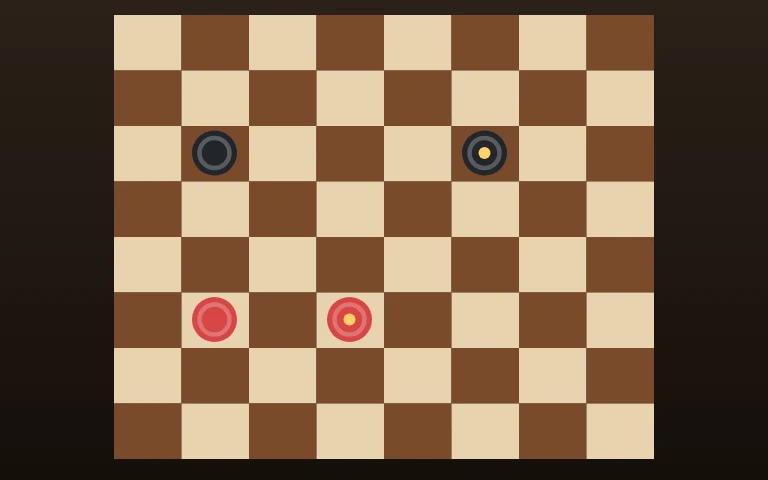
Checkers looks like a simple game of jumping. At any decent level it is a counting game: every capture is a trade, and the winner is whoever sees the trade two moves deeper.
The exchange, not the capture
Taking a piece feels like progress. It is only progress if the sequence ends in your favour.
Before you jump, count the whole sequence:
- Your jump.
- Their recapture, if any.
- Your recapture of that, if any.
A jump that wins one piece and loses two is a bad jump, no matter how good it felt. The board state at the end of the sequence is the only thing that matters — not the piece count in the middle of it.
Count to the end of the sequence or do not jump. There is no third option.
Forced captures are a weapon
In draughts, if a capture is available it usually must be taken. That rule is not a restriction — it is the primary tactical tool, because it means you can *force* an opponent's piece to move where you want it.
The pattern to look for: a square where an opponent's piece would be forced to jump, landing on a square where you can take it. Set that up and their legal moves do the work for you.
Two shapes worth memorising:
- The double offer. Give away one piece so that the recapture lands in a square where you take two.
- The edge trap. Force a capture toward the edge, where the piece has no escape squares and the recapture is guaranteed.
Kings decide the endgame
A king moves in all four diagonal directions, so a single king behind enemy lines can dominate an entire wing. Two rules follow:
- Get a king first. In an even position, the player who crowns first usually wins, because the king can attack while remaining safe.
- Trade toward kings, not away from them. If you are ahead in material, trading pieces is good. If your opponent is closer to crowning, trading is how you lose.
Keep the back row
The back row is your last line of defence: pieces there prevent the opponent from crowning. Moving them forward early is the most common beginner mistake, because it looks active and it is actually a hole.
Move a back-row piece only when: - You need it for a forced capture sequence, or - The opponent has no piece that could reach the crowning row.
Structure beats single pieces
Pieces that support each other cannot be attacked profitably, because any capture of one is answered by the other. So the positional goal is a diagonal chain of two or three pieces protecting each other while advancing.
A single loose piece in the middle of the board is not an attacker; it is a target. Every time you move, ask whether the piece will have support on the square where it lands.
Practical checklist
- Are there forced captures for either side? Resolve them first.
- Does my move create a trade I win, or allow one I lose?
- Does it leave my back row intact?
- Does the piece land supported?
Four questions, ten seconds, and most amateur games are decided by them.