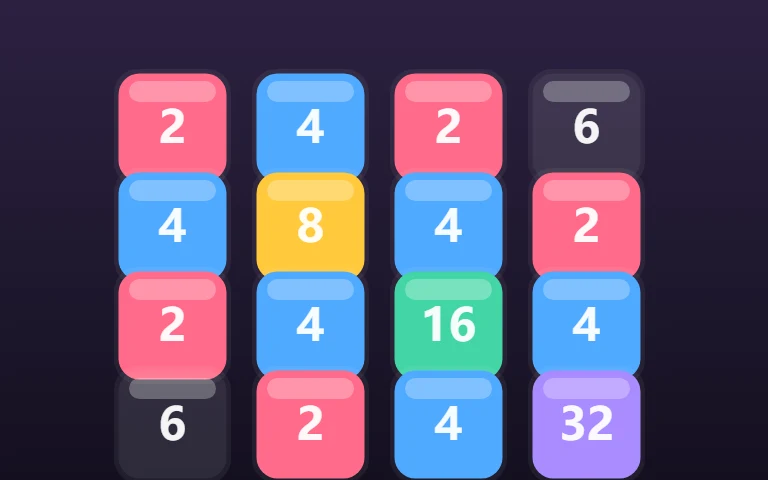
Merge Dice grows a board from one corner while you merge equal neighbours upward: two ones into a two, two twos into a three, and so on, with two sixes detonating for a bonus. New dice keep arriving, so the board is a budget you spend.
Merge forward, never sideways
A merge turns two n into one n+1. The value question is always: does this merge make the next merge closer?
Two twos merging into a three are only useful if a second three already exists (or is one merge away). Before any merge, look for the destination chain: n, n+1, n+2 already on the board. Merging along an existing chain doubles the board's organisation; merging into empty space just rearranges clutter.
- Good: 2,2 next to a 3 — merge, and the 3s pair up.
- Bad: 2,2 alone in a corner — you made a 3 that now needs friends you do not have.
The six is a bomb, and bombs need storage
Two sixes explode and clear for a bonus, which makes sixes feel like the goal. They are actually a liability you are storing: a lone six takes premium space and pairs with nothing.
Rules for sixes:
- Do not build a six until its partner is nearly ready — that means a 4 and a 5 already positioned adjacently.
- Keep detonation pairs close to dense regions, because the explosion buys back breathing room.
- A six in the corner is a wasted vault; keep it central where it can meet its partner from any direction.
Every die is a promise about the next die. A six is a promise you cannot keep yet — so stop promising.
Feed the board from one side
New dice drop in on a schedule, and their values are luck. What is not luck is where they land relative to your structure. Keep your merges anchored to one region so that fresh dice arrive next to your chain instead of scattered across a tidy board.
A board organised into one growing cluster absorbs new dice; a board organised into neat rows everywhere has no room for luck.
Dig, do not stack
When the board crowds, the instinct is to merge whatever is available to "clear space". That flattens your structure — merging 2+2 into a stray 3 destroys the chain that needed those twos.
Instead, work from the bottom of your chain down: find the lowest number that has a partner and merge it, so the merge propagates upward. Merges that propagate keep their promises; merges that terminate just spend space.
The survival clock
There is no win state, only a board that fills. Your score is the sum of merges and detonations along the way — so the real objective is keeping the merge chains alive as long as possible, one planned number at a time.