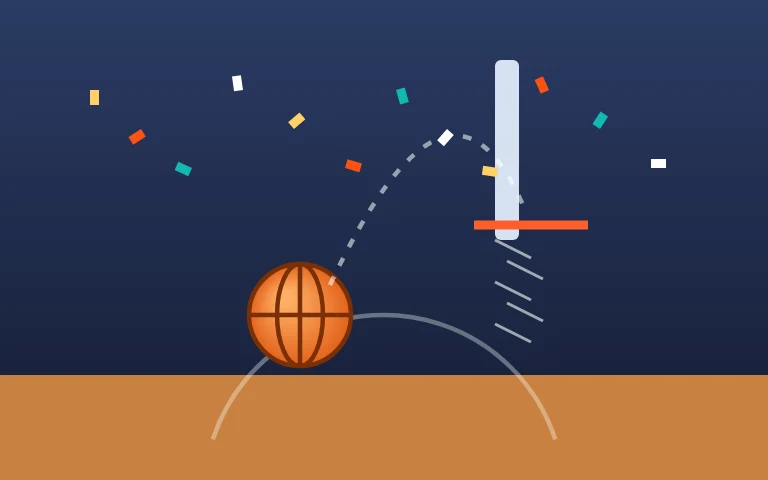
Shooting Hoops is a streak game disguised as a shooting game. You have sixty seconds, the rim moves after every basket, and the only thing that matters is how many attempts you can convert before the clock runs out.
The clock is the real opponent
Sixty seconds is roughly fifteen to twenty realistic attempts. That means each miss costs you not just a point but about three seconds of shot rhythm.
So the correct strategy is not "aim carefully". It is "shoot at a tempo you can repeat". A player who takes a shot every three seconds with a 70% hit rate beats a player who takes a shot every six seconds with a 90% hit rate, comfortably.
One arc, reused
Flick controls read distance and speed. The mistake is to re-learn the flick for every rim position, because the rim keeps moving and you end up aiming consciously on every shot — which is slow and inconsistent.
Instead, calibrate one shot from the position the ball resets to. Find the flick strength that lands centre when the rim is at its default spot. Then, for other rim positions, adjust only the horizontal direction, not the power.
Power is your baseline. Direction is your variable. Swap those two and every shot becomes a guess.
Most rim positions in this game differ horizontally, not in distance. That is why the single-arc method works: distance stays roughly constant, so your power should too.
Bank shots buy margin
The backboard exists to convert near-misses into baskets. A shot that hits the board and drops in is a shot that would otherwise have bounced out.
If your flick tends to run long, aim slightly high and let the board correct it. That is not a crutch — it is using the geometry of the court, the same way real players do.
Protect the streak
Streaks usually multiply score, so the streak is worth more than any single difficult shot. Two rules follow:
- Never take a low-percentage shot while a streak is alive. Wait one beat for a cleaner rim position instead — you lose a second, not a multiplier.
- Take the difficult shot when the streak is already broken. That is when variance is cheap.
The last ten seconds
In the final stretch, stop optimising. Take every shot as soon as the ball returns, because attempts are worth more than accuracy when the clock is nearly gone.
The math is blunt: with five seconds left you can fit two rushed attempts or zero careful ones. Rush.
What to practise
Play three rounds with one constraint: never adjust power, only direction. You will end up with a repeatable release, and a repeatable release is what a timed game actually measures.