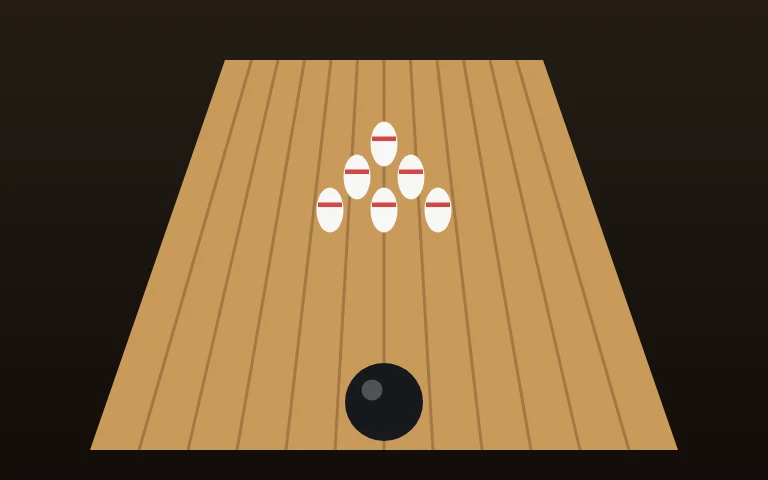
Screen bowling maps your drag onto two things at once: direction and power. That coupling is the whole game — and it is why chasing strikes with hooks is usually a mistake.
The pocket is the target
Strikes do not come from hitting the head pin straight on. They come from the pocket — the gap between the 1 pin and its neighbour — where the ball can drive sideways through all ten.
So the aim is not "the pins". It is a specific board-width target, slightly right or left of centre, and every throw should be judged against that target, not against whether pins fell.
Judge your throws by where they crossed the arrows, not by how many pins fell. Pins are the score; the line is the lesson.
Straight first
A hook looks professional and doubles your variables: now you must control angle and curve. The straight ball has one variable you can actually fix — launch angle.
The training plan that works:
- Ten throws dead straight at the pocket, same power every time. Learn where the ball actually goes versus where you think it goes.
- Once seven of ten cross the pocket, add small angle changes for pin mix.
- Only then, if you like, add curve for style.
Most players invert this and never build the base.
Power has a sweet spot
Max power is not better. At maximum speed, the ball reaches the pins before it can be judged, and light hits deflect unpredictably. At low power, pins flop instead of flying, and leaves get messy.
Pick a power level you can repeat exactly — around two-thirds is comfortable — and keep it fixed for whole games. Consistent speed makes your misses consistent, and consistent misses are correctable.
Reading the leave
What remains after a hit tells you what to fix:
- The 7 or 10 alone: your angle was too straight — widen the entry slightly.
- Splits with a gap in the middle: you hit the head pin flush instead of the pocket.
- Random wide leaves on identical throws: your power is varying — lock the drag length.
Spares win games
The quiet truth of bowling scoring: games are decided by spares, not strikes. A strike is 10 pins plus bonus; a missed single-pin spare is 10 pins gone. Cleaning up the corner pins with a calm straight ball at the board edge converts good frames into great games.
Chase one repeatable line. The perfect game lives inside it.