Puzzle is the loosest genre label in games. It covers everything from a crossword to a physics sandbox, and the only thing the games share is that the player is the one doing the work.
It helps to split the family into six, because each one rewards a different habit.
1. Deduction puzzles
Minesweeper, Sudoku, nonograms. The board contains complete information and a hidden structure; your job is to infer the structure from constraints. The pleasure is certainty — the moment a cell becomes provably safe.
These games train the habit of asking "what does this number rule out", which is why they feel tiring in a good way. They also produce the most frustration, because a single wrong assumption invalidates everything after it.
2. Spatial puzzles
Tetris, pipe rotation, Sokoban, block-fitting. The information is visible; the difficulty is transformation. You have to mentally rotate, slide and pack objects in a space that punishes overhang.
The pleasure here is fit — the click of a shape landing exactly where it belongs. These games age well because the mental rotation skill transfers to packing a suitcase.
3. Pattern puzzles
Match-3, find-the-difference, memory grids. Nothing is hidden and nothing needs rotating; the difficulty is search speed. Your eye has to scan faster than the board changes.
Pattern games are the most accessible and the most disposable: easy to start, easy to stop, and the skill does not transfer much beyond the genre. That is not a criticism — a five-minute game that respects five minutes is doing its job.
4. Number and word puzzles
Merge games, arithmetic sprints, crosswords, anagrams. These lean on retrieval: you know the answer, you just have to find it quickly. The pleasure is fluency, the feeling of a fact arriving without effort.
They are also the easiest to make too hard, because the designer and the player do not share a vocabulary. A word puzzle that is obvious to its author can be impossible to a player who does not know the word.
5. Physics puzzles
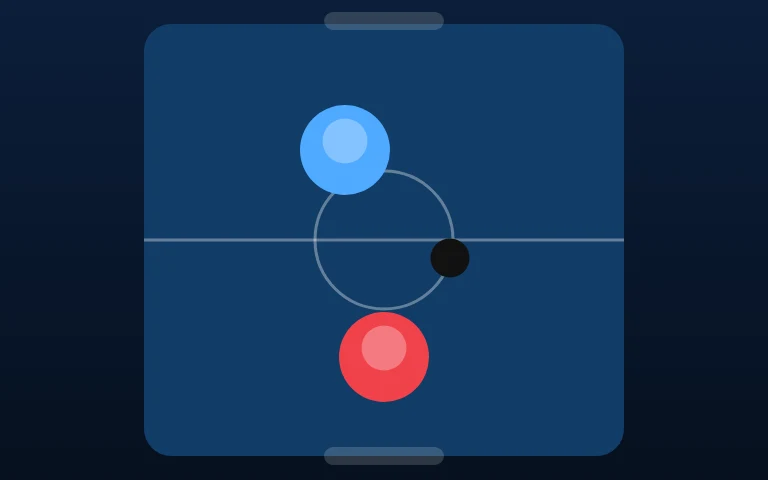
Ricochet aiming, stacking towers, bridge builders. The rules are simple and the outcomes are chaotic; the skill is prediction. You are not solving an equation, you are building an intuition for how a system will behave.
Physics games have the highest ceiling for delight and the lowest tolerance for imprecision. A shot that is two degrees off is a completely different shot.
6. Social deduction
If you have ever played a hidden-role game, you know that the puzzle can be other people. The information is incomplete by design and the constraints are psychological rather than numeric — which is why these games produce stories instead of scores.
Choosing what to play
Match the family to your mood, not to the label:
- Tired but awake: deduction.
- Restless: spatial.
- Distracted: pattern.
- Wanting to feel clever: number and word.
- Wanting to experiment: physics.
- Wanting company: social.
The genre is not a difficulty rating. It is a description of which part of your attention the game is going to borrow.