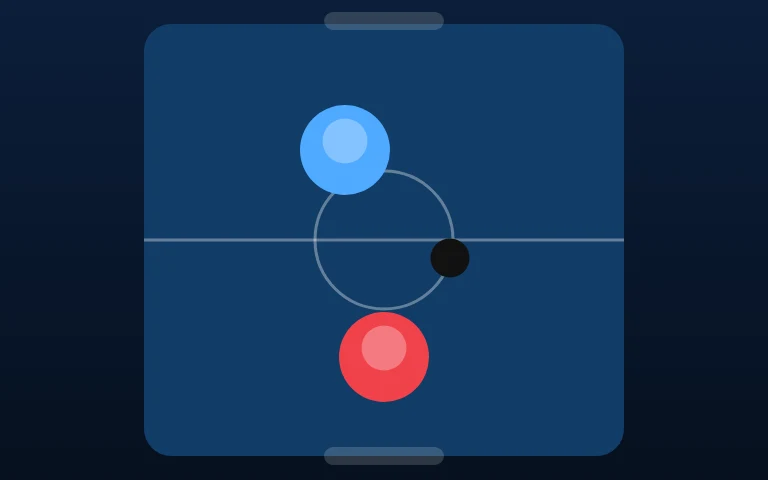
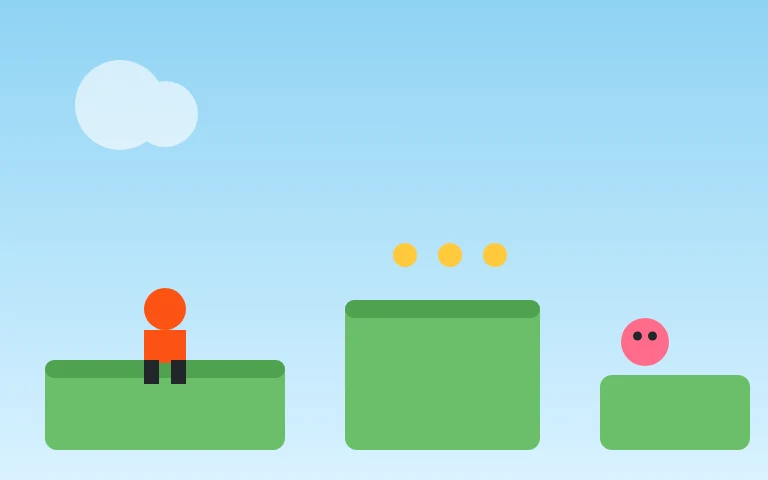
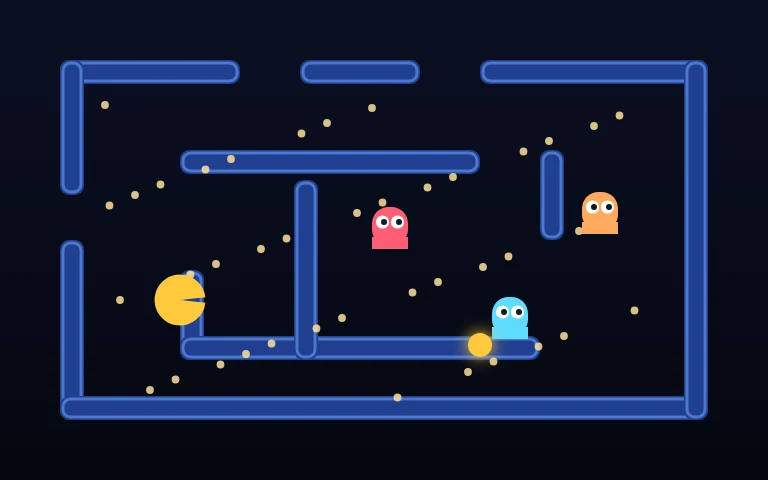
Two versions of the same game can feel like different games. One is crisp and satisfying; the other is technically identical and feels dead. The gap is called game feel, and it is almost entirely made of feedback.
The feedback budget
Every action has a budget of about 100 milliseconds before the brain stops associating the response with the input. Inside that window you can stack: a sound, a flash, a shake, a particle, a number, a small pause. Outside it, the same effects feel like lag.
This is why a hit in a good action game is loud: it is four effects in 80 milliseconds, not one effect at 200.
Anticipation and follow-through
Animation principles apply to shapes as much as to characters. A paddle that leans back slightly before a shot, a tile that scales up before it merges, a coin that arcs before it lands — each one signals what is about to happen and makes the result feel caused.
Follow-through matters more. After the impact, the object should not stop dead: a brick should scatter, a ball should squash, a paddle should recoil. Stopping instantly is what makes a game feel like a spreadsheet.
Screen shake, carefully
Shake is the cheapest effect and the easiest to overuse. The useful version is short (under 200 ms), directional (away from the impact), and small (a few pixels). The bad version is constant, and it makes players nauseous rather than excited.
The best rule: shake the camera only for events the player would flinch at.
Numbers that move
A score that jumps in one step is information. A score that counts up over 300 milliseconds is a reward. The same applies to health bars, combo counters and timers — easing a value from old to new turns a data update into an event.
Sound is half of feel
A silent version of a good game feels broken. Sound carries the timing: a click at the exact frame of contact, a rising tone for a combo, a low thud for a heavy landing.
Because it is synthesised here, each effect is tuned as a shape — attack, decay, pitch slide — which is why a hit sounds like a hit rather than like a beep.
What not to do
- Do not add feedback for things the player did not do. Ambient noise teaches players to ignore sound.
- Do not shake on every event. Ration it.
- Do not make the pause longer than 120 ms. A "juicy" freeze that lasts too long feels like a stutter.
- Do not polish before the rules work. Feel makes a good game better; it does not rescue a bad one.
The test
Play the game with the sound off and the screen small. If it still feels responsive, the animation and timing are doing their job. Then play it with sound on and notice how much of the "fun" was actually audio — usually more than half.