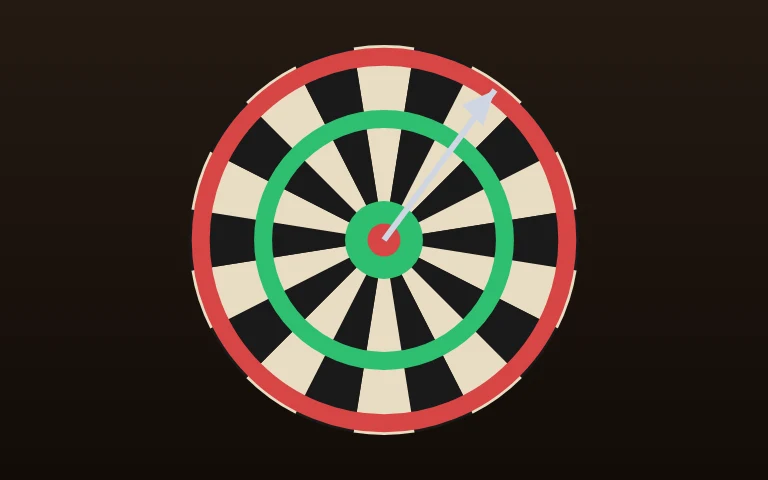
Darts on a screen adds one thing physical darts does not have: a visible, constant wobble. Your cursor is never still. The game is not about steady hands — nobody has them — it is about choosing targets that forgive the wobble.
The wobble is constant, the targets are not
The cursor drifts in a small circle no matter what. So the real question on every throw is: how big is the reward gap between "hit" and "miss", and how big is the target?
Compare two throws with the same wobble:
- Aim at a treble 20: hit it and the throw pays triple, miss by a ring and you score one.
- Aim at the large single-20 area: hit it and you score twenty, and your misses land in neighbours worth one to five.
The treble is the better shot only if you actually hit it more than about one time in six. Most players do not, and the steady single-20 strategy quietly outscores the hero shots over five rounds.
Aim at fat neighbours, not thin ones
Where you aim inside a segment matters as much as which segment. The single 20 is bordered by 1 and 5 — the two thinnest, meanest neighbours on the board. The single 16 is bordered by 8 and 11, both fat.
When two numbers are close in value, prefer the one with fatter neighbours, because your misses score instead of punishing.
Precision players aim at trebles. Everyone else should aim at singles with good neighbours.
Round structure is a budget
Five rounds, three darts each. That is fifteen throws, and the last round is worth the same as the first. The common pattern is a hot start and a cold finish, because players chase an early lucky treble and spend the rest of the game tilted.
Treat the first round as calibration: throw at comfortable targets, learn the wobble's size and direction this session, and only then start pushing for trebles. Calibrated darts 2–5 outscore lucky dart 1.
The bullseye is mostly a trap
The bull pays a lot and is the smallest target on the board. It is worth an occasional end-of-round throw when the round score is already sunk — never a plan.
A simple scoring routine
- Darts one and two: fat single with good neighbours (16, 19).
- Dart three: if the round is going well, a treble attempt; if not, another fat single.
- Adjust after every round based on where your misses actually landed, not where you aimed.
The board tells you the truth about your wobble every single throw. Reading it is the whole skill.