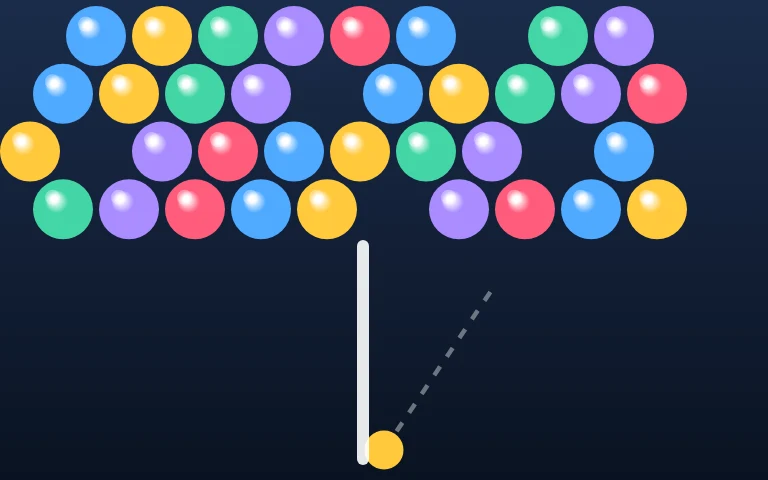
Bubble shooters look like a matching game. They are actually a structural game: the ceiling keeps descending, and every shot you take either removes weight from the board or adds to it.
Count the drop clock
The ceiling pushes down every few shots. That means your real budget is not "shots until I lose" but "shots until the board gains a row" — and a row of new bubbles is much more expensive than a missed match, because it pushes everything closer to your line.
Two consequences follow.
- Clear early, clear often. A cluster removed at the top of the board is worth more than the same cluster removed at the bottom, because the top cluster is what holds everything else up.
- Do not take speculative shots. A wild bounce that misses costs you both the bubble and progress toward the drop.
Bank shots are geometry, not luck
Wall bounces are predictable. The angle in equals the angle out, mirrored around the vertical wall. So a bank shot is just a straight line to a mirrored target.
The practical technique: pick the bubble you want to hit, reflect it across the wall you plan to use, and aim at that reflected position. If the reflected point is off-screen, the shot is impossible — do not try it and hope.
Good bank shots do something a direct shot cannot: they reach bubbles on the underside of an overhang, where a direct line would be blocked by the bubbles in front.
Prune, do not decorate
A common mistake is matching whatever is convenient. Convenient matches usually happen in the middle of a large mass, where removing three bubbles changes nothing structurally.
Look instead for these three shapes:
- A narrow neck. Two or three bubbles connecting a big cluster to the ceiling. Cut the neck and the cluster falls — the single best shot type in the game.
- A colour island. A pair of one colour surrounded by another. Give it a third and it vanishes for almost no cost.
- An early overhang. Any bubble hanging below the main mass with nothing under it. Clearing it opens a firing lane.
Colour discipline
You only carry one colour at a time — the one loaded in the launcher, plus a visible next. That means you should always be planning one shot ahead.
Never fire your current bubble into a spot that makes your next bubble useless.
If your current colour has no useful home, the correct play is often a bank shot that parks it against a wall for a later clear, rather than forcing it into a match that fills a gap you needed.
The last third
When the board is heavy and the ceiling is low, stop chasing large clusters. Switch to a simple rule: every shot must either remove bubbles or place your bubble adjacent to the same colour, so the next one can clear it. Two-shot matches are still matches.
And when the ceiling is one row from your line, spend everything on the biggest structure you can cut. Panic shots that clear three bubbles are how good boards are lost.