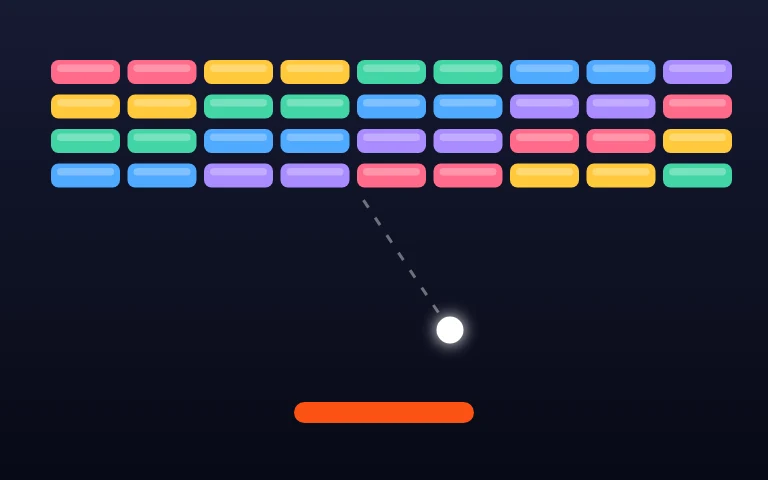
Brick breaker is usually described as keeping the ball alive. That is the beginner version. The real game is deciding where the ball goes next, and that decision is made in the half-second before contact.
The paddle has three zones
Think of the paddle as having a centre, two mid-zones and two edges.
- Centre: the ball leaves almost vertically. Good for control, bad for reaching the sides.
- Mid-zone: a 20 to 35 degree angle. This is your workhorse.
- Edge: a steep 45 degree or more. Use it to break a corner cluster or to send the ball across the wall.
The common mistake is aiming the paddle centre at the ball. Aim the edge zone at the ball when you want an angle, and the centre only when you want to slow the game down.
Digging out a stuck ball
When the ball ends up in a horizontal loop above the bricks, the fix is not to chase it. Move to the side the ball is travelling toward and take it on the edge, so it leaves at a steep angle and breaks the loop.
Trying to catch a looping ball on the centre keeps the loop alive, which is how runs bleed time.
Clear from the bottom
Every brick you remove changes the rebound geometry. Start at the bottom row: it gives you the shortest return path and keeps the ball in the region you control.
Top-row bricks are deceptive — clearing them opens the ceiling, so the ball travels further between contacts and you have less time to reposition.
The last brick problem
With one or two bricks left, the ball tends to fall into a wide orbit and the last brick takes longer than the first twenty. Break the orbit deliberately:
- Use the wall. Aim the ball at the side wall so it arrives at the last brick from an unusual angle.
- Move the paddle late. A last-moment nudge on the edge changes the exit angle without giving the ball time to drift back into its loop.
- Do not chase. Standing under the ball guarantees the same rebound every time.
Lives and speed
Three lives, and speed rises as the level thins out. The correct response to speed is not faster paddle movement but shorter distances: keep the paddle near the centre and let the angle do the travelling.
If you are down to one life, give up on the last row and play safe angles off the mid-zone until the layout is clear enough to finish.
A drill worth doing
Play one level where you are not allowed to hit the ball with the paddle centre. Every contact has to be mid-zone or edge. Your angle control improves more in that one level than in ten normal runs.