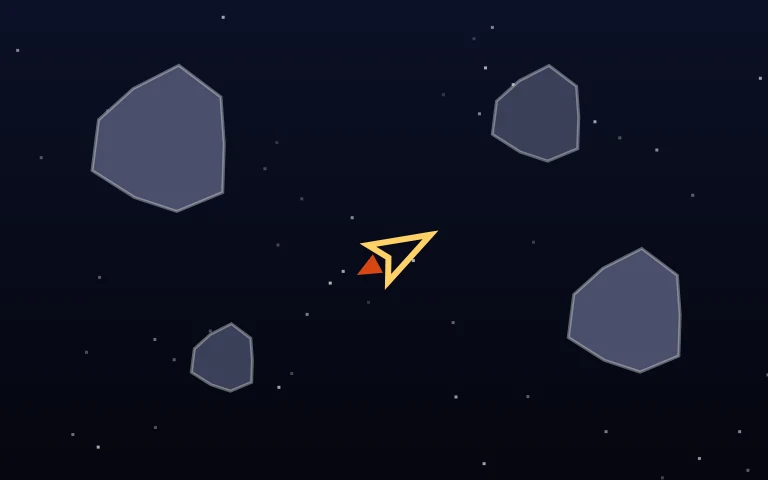
Asteroid Drift looks like a twin-stick shooter and plays like a physics exam. The difference from every other shooter in the genre: momentum. Your ship coasts until you counter-thrust, and every decision is made two seconds before it matters.
Killing velocity is the first skill
New players aim and shoot and wonder why they die. They die because they are always moving — drifting into a rock they saw coming.
The habit that changes everything: stop between engagements. After clearing a threat, counter-thrust until velocity reads near zero, then look around. A stationary ship has all the time in the world; a drifting one has none.
- Rotate to face opposite your motion.
- Thrust until the drift visibly slows.
- Only then aim and shoot.
It feels slow for the first minute. It is the only reason you survive the third.
Shoot the big ones first — from far away
Blasting a large asteroid splits it into smaller, faster pieces. The pieces inherit the breakup position and gain speed, which means the safest place to shoot a big rock is as far from your ship as possible.
The pattern: stop, rotate, put two or three shots into the largest rock on the far side of the field. By the time the fragments reach the middle, you have already handled the closer ones — and fragments arriving at distance are slow and scattered.
Killing big rocks up close hands you three fast rocks in your lap.
Use the edges
Fragments that leave the screen are gone — or they wrap. Either way, the field edges are your ally: steer fights toward the edge, where fragments have somewhere to go that is not your face.
The centre of the field is where every fragment converges on you. Stop choosing the centre.
The wave transition is the trap
Clearing the field starts the next wave, which spawns rocks around the arena. The mistake is to celebrate and drift — spawning rocks appear near your momentum line.
After the last rock breaks: counter-thrust, centre-ish, stop. Then let the wave spawn around a stationary ship you can read.
The safest position at any moment is zero velocity, mid-distance from everything.
Patience scoring
Waves reward clearing, not speed. A slow, clean wave where you never exceed a gentle drift beats a fast one where you trade hull for tempo. There is no timer. The only currency is your ship, and every unit of velocity you do not cancel is a loan against it.