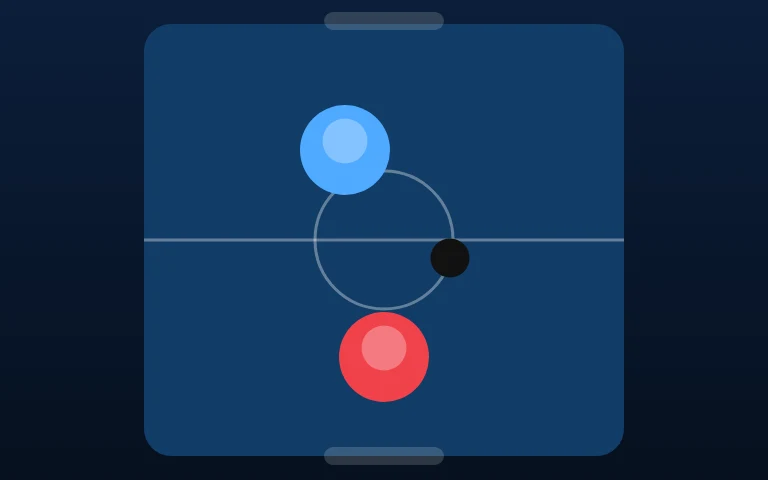
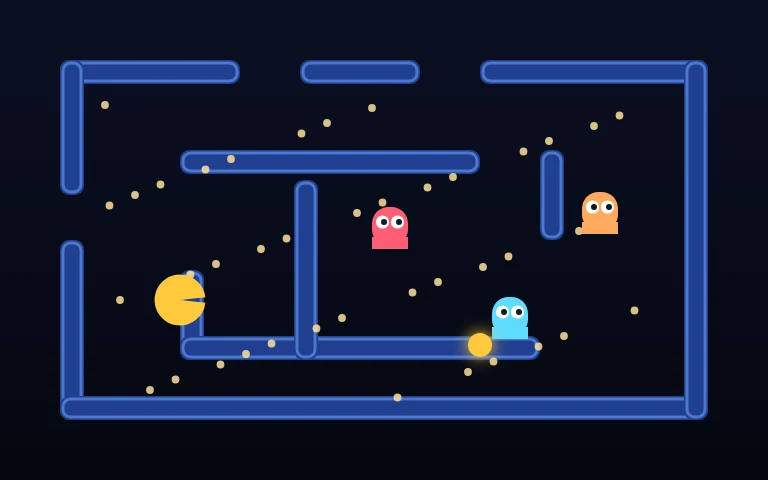
The arcade cabinet was a design school disguised as furniture. Every decision was forced by the business model: a player who does not understand the game in ten seconds will not insert a coin, and a player who understands it too well will play for an hour on one coin.
Constraint one: teach by playing
No tutorials, no tooltips, no first-level exposition. The attract mode demonstrated the game; the first thirty seconds of play taught the rules by making the first action obviously correct.
Modern short games inherited this. The best of them still teach with the first input: tap to flap, drag to aim, swipe to slice. If you need a paragraph, the design is not finished.
Constraint two: readable at a glance
Arcade screens were low resolution and often viewed from an angle, behind glass, in a dark room. So characters were silhouettes, threats were bright, and everything that mattered was larger than it needed to be.
This is the same discipline as drawing with shapes instead of sprites. Legibility beats fidelity when attention is divided.
Constraint three: difficulty as a dial, not a wall
Arcade games are famously hard, but the hardness was tuned: early enemies are slow and predictable, and the curve rises in steps the player can feel. The purpose was to produce a steady stream of near-misses — the run that ends just before the record.
A near-miss is the most valuable moment in a coin-operated game, because it produces another coin. In a free game it produces another minute, which is the same currency.
What the arcade got wrong
- Difficulty as a toll booth. Some machines were hard because difficulty extended playtime per coin, not because it was interesting. Players can feel the difference and they resent it.
- No save, no pause, no exit. Convenient for the operator, hostile to anyone with a life. Modern games should never punish someone for leaving.
- Scores without context. A high-score table with no dates and no names is noise. A best score attached to your own history is a conversation.
What survived
The three-minute loop, the one-line control scheme, the readable screen, the honest score, and the idea that the first ten seconds are the whole pitch.
Everything else — the queue, the coins, the smoke, the standing up — is gone, and good riddance. What remains is a compact theory of how to make a small game feel worth the next ninety seconds.
That theory is still the best thing we have for a game that has to earn attention immediately.