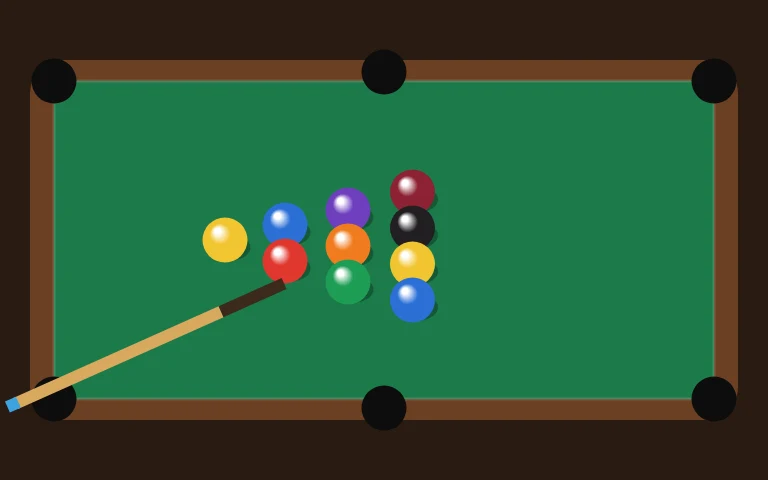
Pool looks like a game about hitting a ball hard in the right direction. It is actually a game about a point that does not exist on the table: the ghost ball.
The ghost ball
To pot a ball, the cue ball must arrive at the object ball travelling along the line that connects the object ball's centre to the pocket. Since the cue ball has the same radius as the object ball, the contact happens when the cue ball's centre is exactly one diameter away from the object ball's centre on that line.
That position — where the cue ball's centre must be at the moment of contact — is the ghost ball. Aiming at it is the whole technique.
How to find it in practice:
- Draw the line from the object ball to the pocket.
- Continue that line *behind* the object ball by one ball diameter.
- That spot is your ghost. Aim the cue ball at it, not at the object ball.
Once you see the ghost, previously impossible cuts become obvious — and shots that looked easy reveal themselves as thin, low-percentage cuts.
Power comes from distance, not from a meter
In this implementation the further you click from the cue ball, the harder you hit. That is a useful control once you understand it: the direction is the line, and the distance along that line is the force.
Two rules follow:
- Never use maximum power unless you must. Extra force narrows your margin of error on the cut and makes position control impossible.
- On short, straight pots, use the least power that reaches. The softer the shot, the more forgiving the pocket.
Hard shots do not go in more often. They just miss more expensively.
Do not scratch
The cue ball in a pocket ends your turn and often costs the game. The scratch risk is highest on two shot types:
- Straight pots where the cue ball follows through. After contact the cue ball keeps travelling — in the direction of the object ball. If that line leads to a pocket, use less power or add a slight angle.
- Thin cuts near a rail. The cue ball deflects at a wide angle and can wander into a corner.
Before every shot, ask: after contact, where does my cue ball go? If the answer is "a pocket", change the shot.
Build the run backwards
The order of pots matters more than any single shot. Work backwards from the eight ball: pick the ball you want to leave for last, then the one before it, and so on.
That way each pot leaves the cue ball in a place that has a next shot. Players who pot whatever is nearest spend the whole rack recovering position instead of building it.
When there is no shot
If no pot is available, do not hit softly and hope. Play a deliberate safety: hit the object ball thin so it drifts to a rail, and send the cue ball to the far end of the table.
A safety that leaves your opponent a long, awkward shot is worth more than a 10% pot attempt that leaves them an easy one.