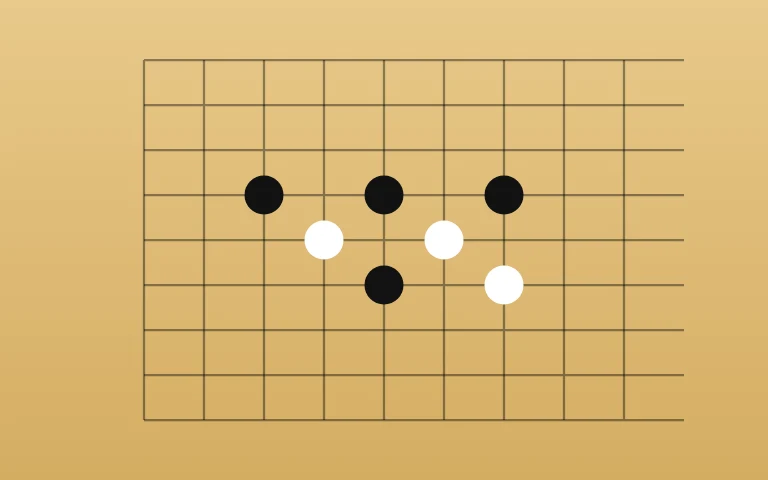
Five in a row looks like a game about lines. It is really a game about double threats — positions where you have two ways to win and your opponent can only block one.
Learn the two winning shapes
Almost every Gomoku game is won by one of two patterns:
- Double four: two separate four-in-a-rows. Blocking one still lets the other complete.
- Four-three: one open four plus one open three. The four forces the block, and the three converts on the next stone.
Everything else — the opening stones, the centre control, the contact fights — exists to build one of these shapes while denying yours.
The priority ladder
On every turn, check threats in this order:
- Can I make five? Play it.
- Can the opponent make five next turn? Block it.
- Can I make an open four (a four with both ends free)? That is a win next turn unless the opponent wins first — so take it only after step 2 is safe.
- Can the opponent make a double threat? Block the key point now, not later.
- Otherwise, build your own threes toward a fork.
Most beginner losses come from skipping step 4. By the time the double threat is visible, the key intersection point is already taken.
Claim the centre, stay connected
The first three or four stones should fight for the middle of the board. Stones near the centre touch more lines in every direction, so the same stone does more work. Keep your stones within one knight-move of each other: disconnected stones defend nothing and threaten nothing.
One practical habit: after each of your opponent's stones, ask "which of my lines did that just weaken, and which of theirs did it just strengthen?" If you cannot answer, you are playing on autopilot.
In Gomoku the board never lies. The winning shape is always visible three stones before it happens — to whoever looks.
Against the computer
The AI blocks, builds and forks, so greedy play loses. Two adjustments work well:
- Never place a stone that creates only one threat unless it also blocks something. Single threats get ignored and punished.
- When the AI builds an open three, respond immediately. An unanswered open three becomes an open four, and an open four is game over.
Draw-oriented play is also fine: against a strong opponent, forcing the game into blocked, symmetrical positions keeps the double threats off the board — and a draw beats a lesson.